
Sports Story
No Room for Legends? Is Indian Cricket Discarding Experience Too Soon?


In the pursuit of youth and agility, is Indian cricket sidelining its stalwarts prematurely, risking the stability and depth that veterans like Virat Kohli and Rohit Sharma provided?
The Great Exodus: Kohli and Sharma’s Test Farewell
In a move that has sent ripples through the cricketing world, both Virat Kohli and Rohit Sharma have announced their retirements from Test cricket. Kohli, with 9,230 runs and 30 centuries, and Sharma, known for his leadership and stability, have been pillars of India’s Test team. Their simultaneous departures raise questions about the timing and the decision-making processes within the Board of Control for Cricket in India (BCCI).
Youth Over Experience: A Strategic Gamble?
The BCCI’s recent inclination towards promoting young talent has been evident. Shubman Gill, a promising 25-year-old, is reportedly being considered for the Test captaincy, signaling a shift towards a younger leadership core . While nurturing young talent is essential, the abrupt transition raises concerns about the potential loss of invaluable experience and mentorship that seasoned players like Kohli and Sharma provide.
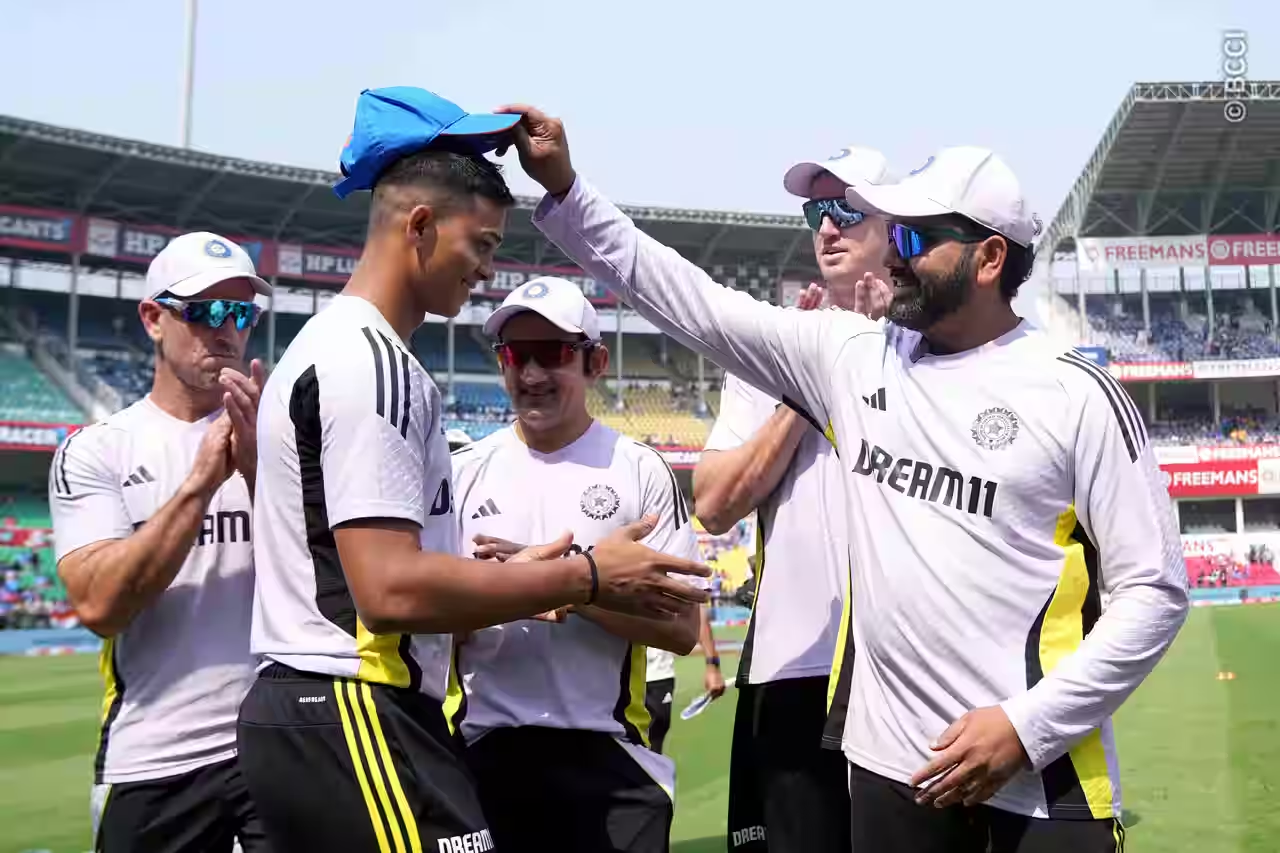
Photo Source: BCCI
The IPL Effect: Overconfidence in Short Formats
India’s success in the Indian Premier League (IPL) has been monumental, transforming cricket into a lucrative and glamorous sport. However, this success may have inadvertently led to an overemphasis on the shorter formats of the game. The skills and strategies required in T20 cricket differ significantly from those in Test matches. Relying heavily on IPL performances as a benchmark for Test selection could be a misstep, as the nuances of the longer format demand a different skill set .
Current State: A Team in Transition
India’s recent Test performances have been inconsistent. The team faced a 3-1 series defeat in Australia during the 2024-25 season, highlighting vulnerabilities in both batting and bowling departments . With the impending five-Test series in England, a country where India has historically struggled, the absence of experienced players could pose significant challenges.
The Talent Pool: Depth or Illusion?
While India boasts a vast pool of cricketing talent, the readiness of these players for the rigors of Test cricket remains uncertain. The transition from domestic or IPL success to the international Test arena is substantial. Without the guidance of seasoned players, young cricketers may find it challenging to adapt to the pressures and demands of Test matches.
Balancing Progress with Prudence
The evolution of Indian cricket is inevitable and necessary. However, the manner and timing of transitions are crucial. Phasing out legends like Kohli and Sharma without a structured succession plan could lead to instability. A balanced approach that integrates youth with experience may serve Indian cricket better in the long run.
#IndianCricket #TestCricket #ViratKohli #RohitSharma #BCCI #CricketTransition #IPLImpact #CricketStrategy #TeamIndia #CricketLeadership




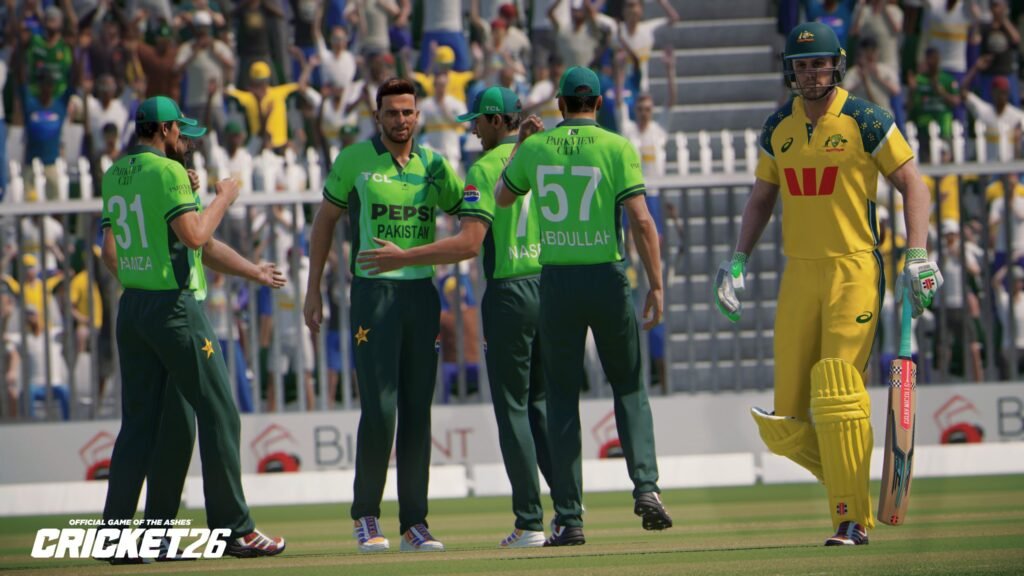
In its current state, Cricket 26 is not merely a bad game; it is a non-functional product sold at a premium price. The 0.5 point in the rating below is a charitable acknowledgment of the artists who worked on the graphics and the scribbled notes somewhere that contained good ideas. Everything else—the broken gameplay, the stolen fun, the betrayal of community trust—actively subtracts from the experience. This rating reflects not just poor quality, but the active harm done to the cricket gaming landscape and its passionate fans.
Rating: 1.5 / 10
We retain a sliver of hope that Big Antz will heed this unified call. Should they channel their expertise into correcting these foundational errors, a redemption story could be written. We would be overjoyed to compose a follow-up, praising a genuine comeback. Until then, this rating stands as a warning and a testament to one of the most squandered opportunities in recent sports gaming history.
There is a profound difference between a game that is challenging and a game that is broken. One tests your skill; the other tests your patience. With Cricket 26, Big Antz Studios—a seasoned veteran in digital cricket—has tragically delivered the latter. This is not merely a critical review; it is a chronicle of promise unfulfilled, of grand ambition colliding with a shocking disregard for foundational quality. The ideas behind this installment are among the best the studio has ever conceived, yet the execution has produced what is, in its current state, their most dysfunctional and frustrating release to date.
The Phantom Promise: What Could Have Been
To be fair, the blueprint for a masterpiece is visible. Cricket 26 boasts the most impressive graphical fidelity the series has seen. Stadiums are detailed, player models are refined, and the initial presentation hints at a deeper, more immersive simulation. The intent to create a nuanced, competitive, and authentic cricket experience is commendable. For a fleeting moment, it feels like the next evolution.
The most stinging betrayal is financial. Loyal fans and competitive online gamers, yearning for a next-generation cricket experience, waited patiently and invested a full USD 60 in a Day 1 copy. What they purchased was not a polished product but an unstable, glitch-ridden beta masquerading as a finished game. This isn’t just disappointment; it’s a calculated breach of trust. Players paid for the thrill of competition, the joy of stroke play, and the integrity of online leagues. Instead, their investment returned a torrent of crashes, teleporting fielders, and exploitable physics that robbed them of fun and fair play from the very first session.
Then, you start playing.
The Ten Commandments of Failure: Why Cricket 26 Crumbles
What follows is a systemic breakdown of the core experience, a list of failures so fundamental they baffle the mind given the developer’s pedigree.
-
The Pathetic Patch Cycle: Updates have been deployed, yet core game-breaking issues persist. This isn’t a matter of fine-tuning; it’s a failure to address the engine’s rot, eroding all player trust.
-
The Teleportation Debacle: Fielders do not run; they stutter and warp across the turf. This isn’t a minor visual bug—it destroys match physics, makes a mockery of strategy, and shatters immersion instantly.
-
Chronic Instability: The game crashes with predictable regularity, especially during online matches. There is no greater insult than a disconnected game, robbing players of time and competitive effort.
-
The Powerless Bat: Batting feels like swinging a feather. Shots, particularly on the off-side, lack any visceral weight or power. Perfect timing yields mediocre results, stripping away the basic reward of connection.
-
Unnatural, Unreadable Swing: The ball physics defy logic. Swing is exaggerated and erratic, making it impossible to judge line and length consistently. You’re not reading the bowler; you’re deciphering a glitch.
-
The Online Bowling Meta-Game: This broken swing creates an unfair online environment. Human bowlers exploit it to deliver unplayable, spot-bowling spells that feel less like skill and more like an abuse of faulty mechanics.
-
Superhuman, Anticipatory Fielding: Fielders are psychic athletes with magnetized hands and rocket arms. They consistently perform reactionary saves that are physically impossible, turning potential boundaries into certain dot balls.
-
Dull, Washed-Out Broadcasts: For a sport of vibrant colors, the in-game presentation is surprisingly flat and lifeless, particularly when streamed. It lacks the punch and dynamism needed for modern digital content.
-
Cross-Platform Chaos: The experience is wildly inconsistent across consoles, with varying crash rates and performance issues. There is no standard version of the game, only varying degrees of broken.
-
The Frustration Symphony: All these elements combine into an online experience that is the antithesis of fun. It is a glitch-ridden, unstable, and deeply unfair arena that actively punishes players for participating.
How Does a Veteran Stumble on the Basics?
This is the central, bewildering failure. Big Antz created Cricket 19, a game remembered fondly for its balance and enjoyability. With Cricket 26, the pursuit of a specific, hardcore realism has seemingly overwritten the fundamental need for a stable, fair, and enjoyable gameplay loop. A game can be a bowler’s paradise without feeling like a batter’s torture chamber engineered by bugs.
A Roadmap to Salvation: What Must Be Fixed
The path forward is clear, defined by community outcry:
-
Priority Zero: Stability. One dedicated, massive patch to eliminate crashes and teleportation glitches. Nothing else matters until this is achieved.
-
Restore the Power: Rebalance batting to make shot-making feel powerful and rewarding. A well-timed drive should race to the boundary.
-
Sanity in Physics: Overhaul ball swing and fielding mechanics to be challenging yet predictable and fair.
-
Purify Online Play: Invest in netcode and integrity to make online matches about skill, not exploitation.
-
Polish the Presentation: Inject vibrance and dynamism into the visual broadcast package.
Conclusion: A Hope Against Hope
Cricket 26 is a ghost of a great game. Its potential haunts every glitch-filled session. This review, critical as it is, is written with a reluctant heart. We see the diamond underneath the rubble.
The difference between a hard game and a broken one is the difference between a worthy opponent and a broken controller. Right now, players are fighting the latter.
We retain a sliver of hope that Big Antz will heed this clear, unified feedback. Should they channel their expertise into correcting these foundational errors, a remarkable redemption story could be written. We would be overjoyed to compose a follow-up, praising one of gaming’s great comebacks. Until then, the wait for a truly great modern cricket game continues—a wait made all the more bitter by knowing how close, and yet how far, Cricket 26 actually is.


Gill and Jaiswal’s Historic Stand Ignites Hope. But Can India’s Heirs Outlast England’s Onslaught—and Escape the Shadows of Giants?
The hallowed turf of Headingley has witnessed cricket revolutions before – Botham’s Ashes, Stokes’ Miracle. On June 20, 2025, under a searing Yorkshire sun, it may have birthed another. Shubman Gill, 25, India’s youngest-ever Test captain, raised his bat not merely to celebrate a century, but to herald a new epoch. Beside him, Yashasvi Jaiswal, 23, lay sprawled in agony and ecstasy – his forearms locked in cramps, his name etched into history as the first batter to score debut Test tons in Australia, the Caribbean, and England. Their twin monuments – Gill’s regal 127*, Jaiswal’s grit-soaked 101 – propelled India to 359/3 on Day One against a depleted England. A nation braced for post-Kohli oblivion instead saw its future blaze to life. But cricket’s cruel poetry demands a second act: Can these crown princes convert a glorious dawn into an enduring reign?
The Coronation and the Crucible
Gill’s ascension was inevitable yet perilous. He stepped into a vacuum left by titans – Kohli, Rohit Sharma, R. Ashwin – retired; the World Test Championship mace, slipped from Indian grasp weeks prior. Critics whispered: too young, too untested overseas (average: 35 outside Asia). His answer was a masterclass in leadership alchemy. Eschewing flamboyance for frosty control, he deflected 17 deliveries to third man – a tactical sieve draining England’s hope. In joining Hazare, Gavaskar, and Kohli as centurion captains on debut, Gill didn’t just score runs; he authored a manifesto.
Jaiswal’s saga was raw theater. England bombarded his ribs with 24 bodyline deliveries in 92 balls. He retreated, recalibrated, then revolted – 88% of his runs scorching through the off side, a defiant rebuke to his tormentors. His century, completed through trembling cramps, wasn’t just runs; it was a generational statement of resilience. “He doesn’t just have talent,” observed Rahul Dravid. “He has the mind of a hunter.”
The Delicious Weight of Suddenly Soaring Hope
This was no mere strong start; it was narrative alchemy. India arrived braced for transition trauma – visions of 2014’s 1-3 drubbing haunting memory. Instead, Gill and Jaiswal transmuted dread into delirium. That colossal 359/3 didn’t merely dominate a day; it shattered psychological barriers. The question shifted overnight from “Can they survive?” to “Can they conquer?” Two Test wins in England – once a pipe dream for this callow squad – now feels like the minimum down payment on a dynasty. The burden has magnificently, terrifyingly, shifted: Gill’s cubs must now prove this was genesis, not mirage.
The Pitch and the Pendulum
Yet context hangs heavy over Headingley’s sun-baked strip. This was no green-tinged Leeds gremlin; it was a docile highway under cloudless skies. England’s attack, stripped of Anderson (rested), Broad (retired), Wood, and Archer (injured), resembled a shadow squad – skipper Stokes toiled heroically but exhaustedly, flanked by rookies Carse (nervous) and Tongue (wayward). As analyst Sidharth Monga noted, it was “elite batters feasting on an attack begging to be devoured.”
The True Test Begins Now:
The pitch’s character remains unproven until Jasprit Bumrah, India’s pace emperor, unleashes his thunder. Can this attack – fierce but unseasoned in English trench warfare – exploit even this benign canvas? Victory isn’t woven from 359/3; it’s forged by taking 20 wickets, twice. When Stokes, Root, and Brook march out, Bumrah’s roar must shake Leeds. Will the surface crack under his fury, revealing hidden demons? Or will it remain a batting Arcadia, rendering India’s Day One dominance a beautiful, futile pyre? The answer will define this series – and perhaps, an era.
Gambhir’s Gambit and the Ghosts of Giants
Lurking behind Gill’s on-field aura is Gautam Gambhir, India’s combative new tactician. His fingerprints are on Gill’s pre-series vow: to build “a team for 10-15 years,” even playing “four tailenders” to hunt 20 wickets. This merciless ethos mirrors Gambhir’s own granite resolve. But his strategy faces immediate trial: Bumrah’s workload is a time bomb (he may miss Tests); the spin cupboard beyond Jadeja looks bare. Can Gambhir’s blueprints outmaneuver Stokes’ ‘Bazball’ blitzkrieg?
The shadows loom long. Kohli was India’s last conqueror here (2007). Tendulkar’s audacious 3-1 series prediction now electrifies rather than amuses. Pant’s swashbuckling 65* – capped by a last-over six – radiates the new fearlessness. But legacy demands more than flashes. Lord’s seam, Old Trafford bounce, Archer’s impending return – these are the gauntlets awaiting. Can Jaiswal’s voracious hunger sustain a five-Test war? Will the untested middle order crumble or crystallize under fire?
THE VERDICT:
June 20, 2025, was more than cricket; it was coronation theatre. Gill, Jaiswal, and Pant didn’t just fill voids – they declared a future. Yet dynasties aren’t declared at dawn on docile decks against ghost attacks. The true measure of this “new era” begins when England’s batters counterpunch, when clouds gather over Lord’s, when Bumrah’s magic must conjure wickets from dust. Gill’s India has announced itself. Now, it must prove itself – not for a day, but for a decade. The ghosts of Kohli, Dravid, and Tendulkar watch, sceptical and hopeful. History’s pen hovers.
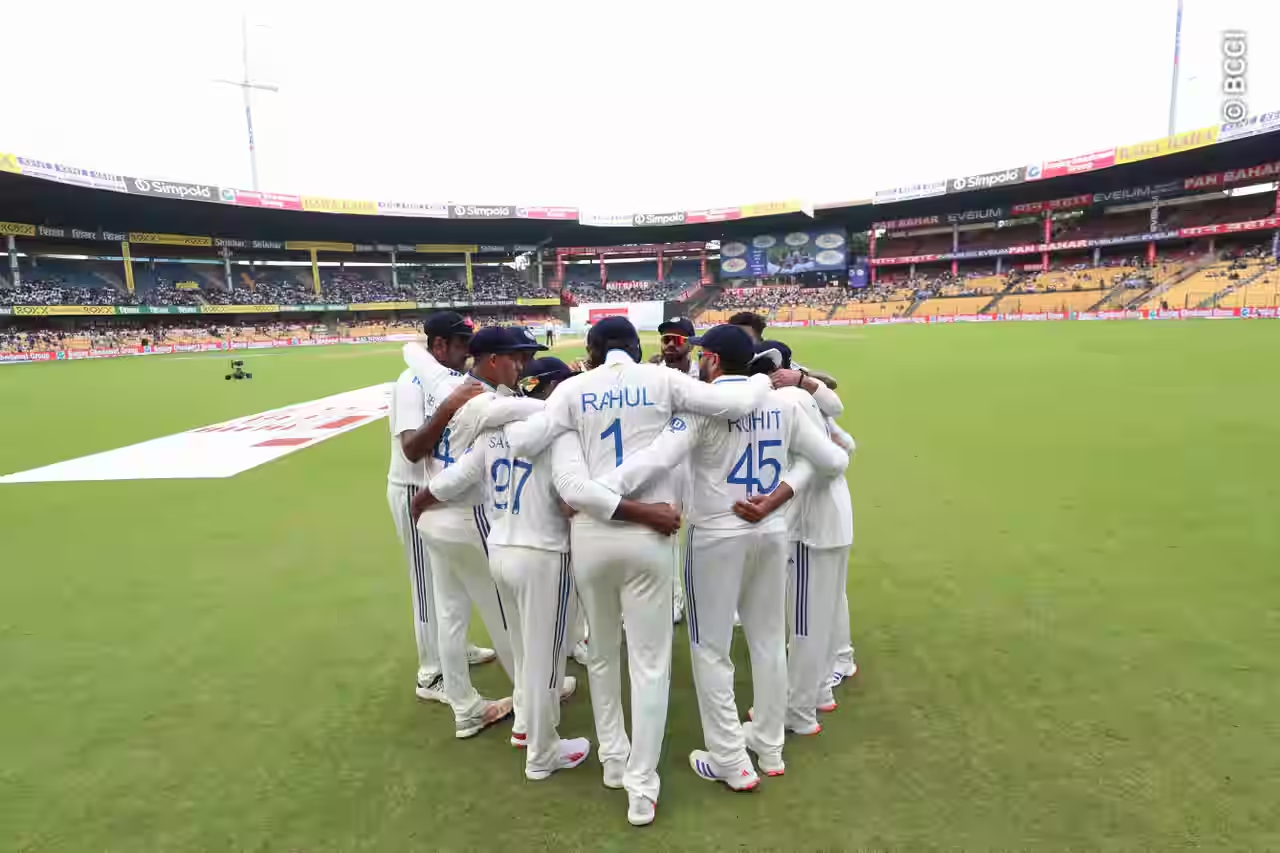
With the departure of stalwarts Virat Kohli and Rohit Sharma from Test cricket, India stands at a crossroads. Who will steer the ship in this new era?
Cast Your Vote: Who Should Be India’s Next Test Captain?
As India embarks on a transformative phase in Test cricket, the leadership mantle is up for grabs. The contenders—Shubman Gill, Jasprit Bumrah, KL Rahul, Shreyas Iyer and Rishabh Pant—each bring unique strengths to the table. Your opinion matters in shaping the future of Indian cricket.
The Post-Kohli-Rohit Era: A Leadership Vacuum
With the recent retirements of Virat Kohli and Rohit Sharma from Test cricket, Indian cricket stands at a pivotal juncture. Their departures have created a leadership vacuum, prompting the Board of Control for Cricket in India (BCCI) to deliberate on the next Test captain. The decision is not merely about appointing a new leader but about setting the direction for India’s Test future.
Comparative Overview of Candidates
| Candidate | Age | Leadership Experience | Test Experience | Injury Concerns | Leadership Style |
|---|---|---|---|---|---|
| Shubman Gill | 25 | IPL Captain | Moderate | Low | Calm and Strategic |
| Jasprit Bumrah | 31 | Stand-in Test Captain | High | High | Tactical and Inspiring |
| KL Rahul | 33 | Multi-format Captain | High | Moderate | Composed and Reliable |
| Rishabh Pant | 27 | IPL Captain | Moderate | Moderate | Aggressive and Dynamic |
| Shreyas Iyer | 30 | IPL Captain | Low | Low | Innovative and Bold |
Photo Credit: BCCI
Shubman Gill: The Youthful Contender
At 25, Shubman Gill has emerged as a frontrunner for the Test captaincy. His leadership of the Gujarat Titans in the Indian Premier League (IPL) has showcased his strategic acumen and calm demeanor. Gill’s batting prowess is evident, but questions remain about his readiness to lead in the demanding Test arena, especially with a modest average of 29.50 in overseas Tests.
Jasprit Bumrah: The Experienced Campaigner
Jasprit Bumrah, India’s premier fast bowler, has previously captained the Test side, including a notable win in Perth against Australia. His tactical intelligence and on-field leadership are commendable. However, his recurring injuries raise concerns about his availability for extended Test series. Reports suggest that Bumrah has opted out of the captaincy race, focusing on managing his workload.
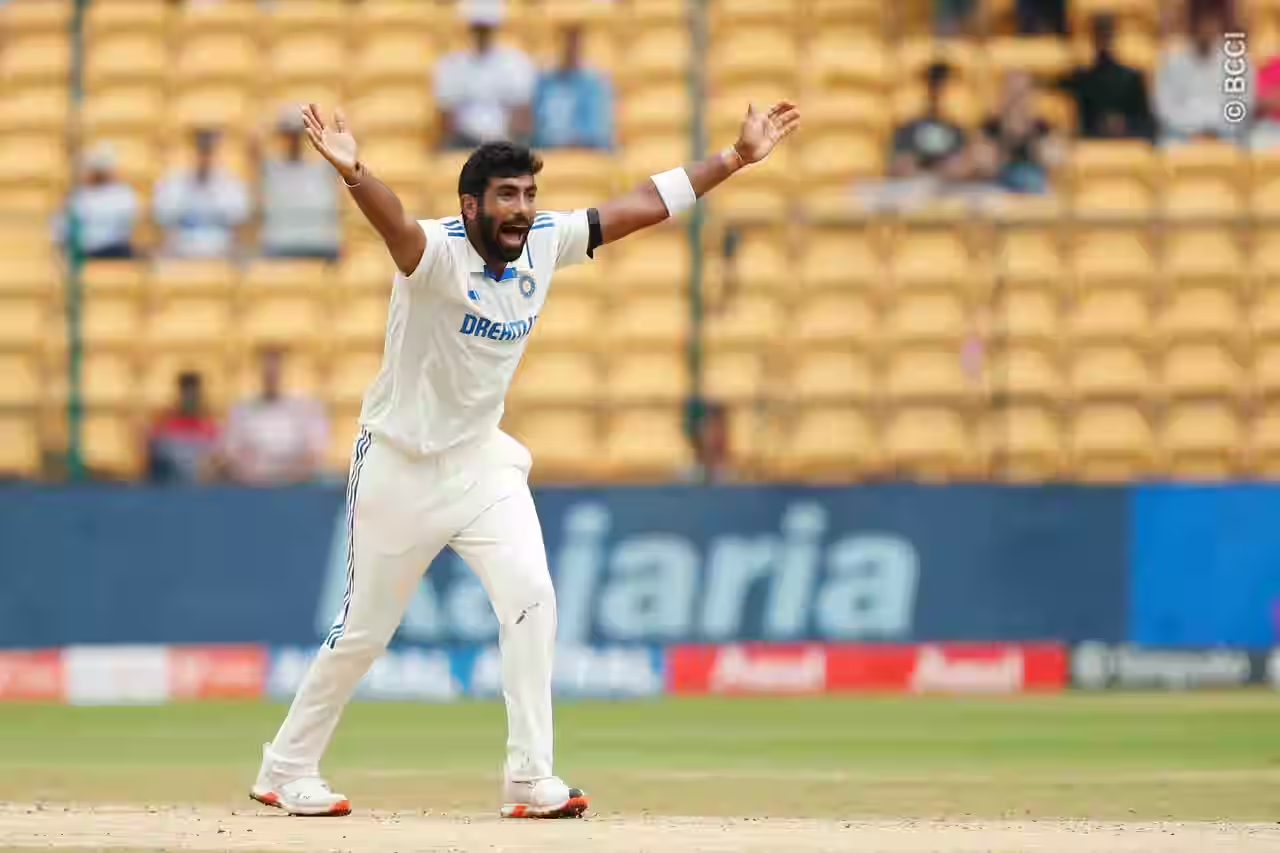
Photo Credit: BCCI
KL Rahul: The Steady Hand
KL Rahul brings a wealth of experience and a composed approach to leadership. Having captained India in various formats, his understanding of the game is well-regarded. However, his recent form and injury history may influence the selectors’ decision. Rahul’s experience could provide stability during this transitional phase.
Rishabh Pant: The Dynamic Option
Rishabh Pant’s aggressive playing style and fearless attitude have made him a fan favorite. His leadership in the IPL has demonstrated his ability to inspire and manage a team effectively. Despite his recent return from injury, Pant’s energy and innovative mindset could inject a new dynamism into the Test side. However, his relative inexperience in leadership roles at the international level may be a consideration for the selectors.
Shreyas Iyer: The Dark Horse
Shreyas Iyer’s leadership of the Kolkata Knight Riders has been characterized by tactical astuteness and the ability to galvanize his team. While he hasn’t been a regular fixture in the Test side recently, his leadership qualities and batting prowess make him a candidate worth considering. His appointment would signal a bold move by the selectors, emphasizing a strategic shift towards nurturing leadership talent.
Strategic Considerations for the BCCI
The BCCI’s decision will reflect its broader strategy for Indian cricket’s future. Balancing the need for fresh leadership with the demands of Test cricket is crucial. The upcoming five-Test series in England presents a formidable challenge, requiring a captain who can navigate the team through demanding conditions. The choice will also signal the BCCI’s commitment to either continuity or a bold new direction.
A Defining Moment
The selection of India’s next Test captain is more than a routine appointment; it’s a defining moment that will shape the team’s trajectory in the coming years. Each candidate offers a distinct blend of skills and leadership qualities. The BCCI’s choice will reflect its strategic priorities and vision for Indian cricket’s future.
#IndianCricket #TestCaptaincy #ShubmanGill #JaspritBumrah #KLRahul #RishabhPant #BCCI #CricketLeadership #TeamIndia #CricketStrategy

The Cover Story World is a premier global platform that showcases the world’s most influential and fastest-growing leaders across business, innovation, culture, and impact. Known for its authoritative rankings, exclusive leadership features, and international summits, The Cover Story highlights the people and ideas redefining success in the 21st century. From industry disruptors to purpose-driven entrepreneurs, it’s where visionary leadership meets global recognition—amplifying stories that inspire, influence, and lead the world forward.

Iran War Live Updates: Israel Says It Has Killed Iran’s De Facto Leader

Why Won’t Europe Help Trump in Iran? Let’s Count the Reasons.

Hundreds Dead in Pakistani Airstrike on Kabul, Officials in Afghanistan Say
Israeli Strike in Gaza City Kills at Least 11 People, Officials Say

The Cover Story World Best Leaders 2025, Yalda Hakim: The Voice That Can’t Be Ignored

Environmental Groups Face ‘Generational’ Setbacks Under Trump

Politics, Pressure, or Progression? The Real Story Behind the Dual Retirements of Rohit Sharma and Virat Kohli

Want AI-Driven Productivity? Redesign Work

Remote Work Evolution: How Indian Corporates Are Redefining Workspaces



-
News Shots8 months ago
Israeli Strike in Gaza City Kills at Least 11 People, Officials Say
-
 Leaders Story10 months ago
The Cover Story World Best Leaders 2025, Yalda Hakim: The Voice That Can’t Be Ignored
-
News Shots7 months ago
Environmental Groups Face ‘Generational’ Setbacks Under Trump
-

 Business Story11 months ago
The AI Founders’ Dilemma: Building Startups in the Shadow of Big Tech
-
 Brand Story2 years ago
The Best 30 Emerging Indian Brands: Innovators Shaping the Future
-

 Business Story10 months ago
Amrit Acharya: Building the Infrastructure of a New World
-

 Brand Story9 months ago
MAGGI’s Environment Day Campaign Blends Humor and Impact with ‘Fridge Follies & Clothesline Capers
-
 The Cover Story2 years ago
Top 10 Game-Changing Business Trends to Watch Out for in 2024