
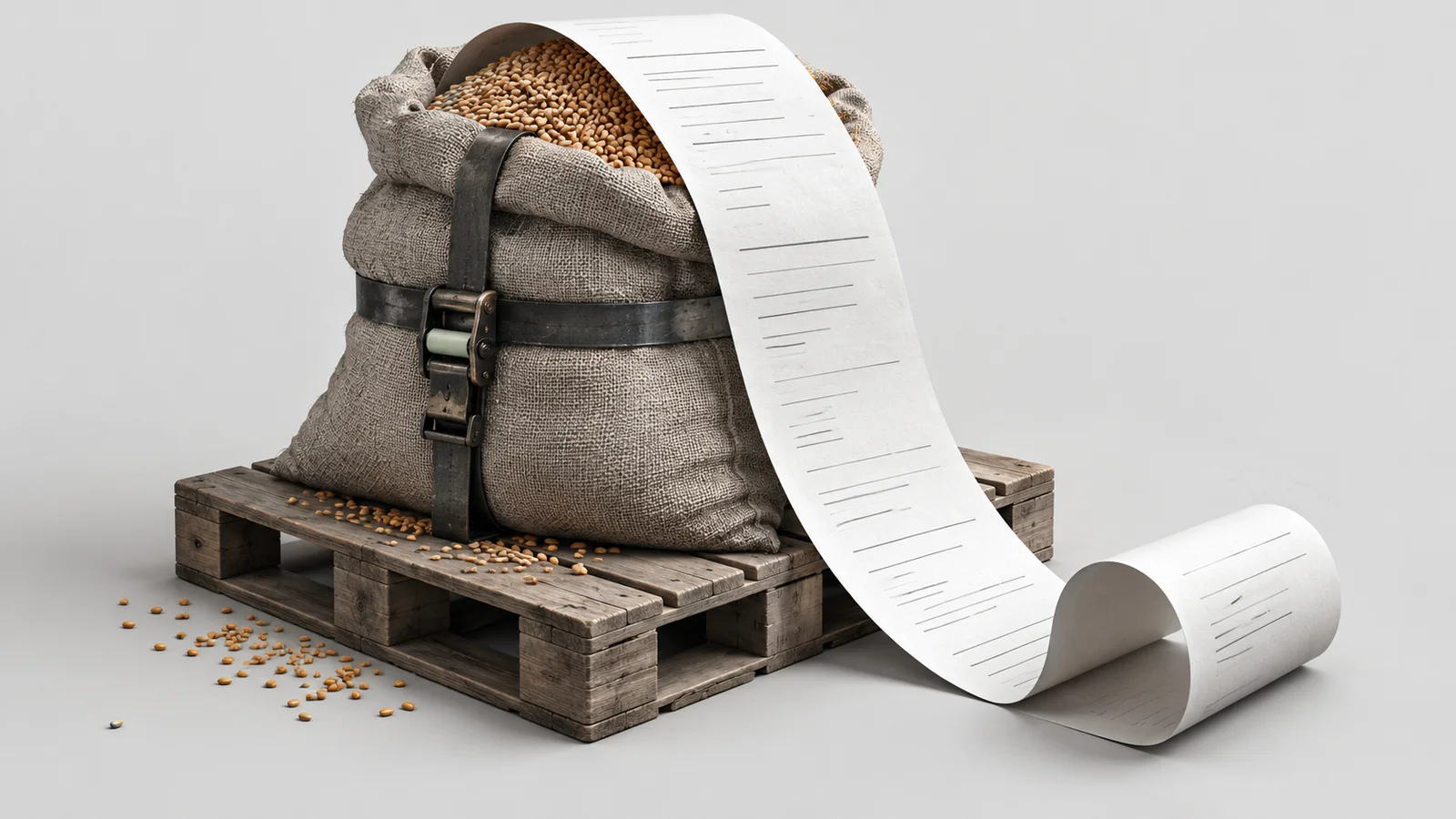
The price of a food shipment is not the price of a family’s dinner. A commodity can become more expensive on an international market without every supermarket immediately changing its labels. Equally, a household can face a higher bill even when the world price of one ingredient has stopped rising.
The latest FAO Food Price Index gives a reason to follow that journey. Released on 2 October, the September reading averaged 136.0 points, up 1.5% from August and 5.8% from a year earlier. The basket tracks internationally traded food commodities, not a representative supermarket bill. Its movement is an early part of the story, not the final receipt. [1]
The most useful question is therefore not simply whether “food” is getting dearer. It is which food, in which market, through which route—and what changes before it reaches the shelf.
The basket is not the shop
FAO’s index combines five commodity groups using export-based weights. September’s components did not all move together: cereals and sugar rose more sharply, vegetable oils increased more modestly, while meat fell and dairy was broadly stable. An overall increase does not mean every product in the basket rose. [1]
A household’s purchases are weighted differently. One may spend more on a particular staple, another on fresh produce or prepared food. A retailer also sells processing, packaging, storage and convenience along with the agricultural ingredient. Reading the international index as a direct retail inflation rate leaves all of that out.
This does not make the international data unhelpful. It tells readers where pressure may be entering the chain. It also identifies the next question for a local investigation: how much of the relevant food is imported, under what contracts, and how quickly do new costs reach the businesses that sell it?
FAO itself distinguishes the international index from its monitoring of domestic food prices. The two are complementary sources, not substitutes. [2]
A border adds another price
Consider the currency step. If an importer pays for a shipment in a foreign currency, the local-currency cost depends on both the commodity quotation and the exchange rate. A lower international price need not bring a lower domestic cost if the currency used by the buyer has weakened sufficiently. The reverse is also possible.
That is arithmetic, not a claim about every country’s current experience. It is precisely why a local retail story needs a matching period and market rather than a world index pasted beside a grocery photograph.
Timing adds another complication. A contract agreed earlier may delay the effect of a new quotation. Stocks bought at an earlier price can do the same. Once those arrangements change, the pressure may appear later than the original market headline. A delay is not, by itself, proof that a seller is withholding a saving.
The appropriate test follows actual purchasing and selling conditions. It asks when the relevant cost changed, what share of the final price it represents, and whether other costs moved in the opposite direction.
The journey has a cost too
Transport can transmit pressure across products that do not share the same farm or harvest. The EIA’s explanation of diesel pricing identifies several stages between crude oil and a delivered fuel price, including refining and distribution. That helps explain why a transport-dependent business may face a cost change that cannot be read from the crude benchmark alone. [3]
For food, the effect depends on the chain. A perishable product requiring reliable delivery and cooling has a different cost structure from a dry commodity that can be stored for longer. An argument about transport should therefore identify the activity it affects, not attribute every price increase to the same fuel story.
There is also a choice over who absorbs the change. A business might accept a smaller margin, raise a selling price, change a supplier or alter the product. Which response is feasible depends on its circumstances. A consumer sees the result, not necessarily the separate pressures that produced it.
That is why claims of excessive pricing need more than two lines moving apart. They require evidence about costs, competition and margins. The opposite claim—that every increase merely reflects unavoidable costs—needs evidence too.
A falling rate can still leave an expensive basket
Another common confusion concerns the price level and the rate at which it changes. If an item becomes more expensive and then stays at that higher price, its inflation rate can fall without restoring its old price. A household can therefore hear that inflation is easing while still needing more money for the same purchase.
Affordability adds income to the comparison. The question is not only how the basket changed, but whether the household’s resources changed with it. An average also cannot describe every household equally, particularly when the composition of essential spending differs.
The next useful food-price story should begin where the international release ends. Match the commodity with a domestic series, follow the exchange rate and relevant delivery costs, and examine what the household actually buys.
The checkout is where the pressure becomes personal. Understanding it means tracing the receipt backwards—without pretending that the first price in the chain is the last word.
Sources & notes
Explore the sources cited in this article.