
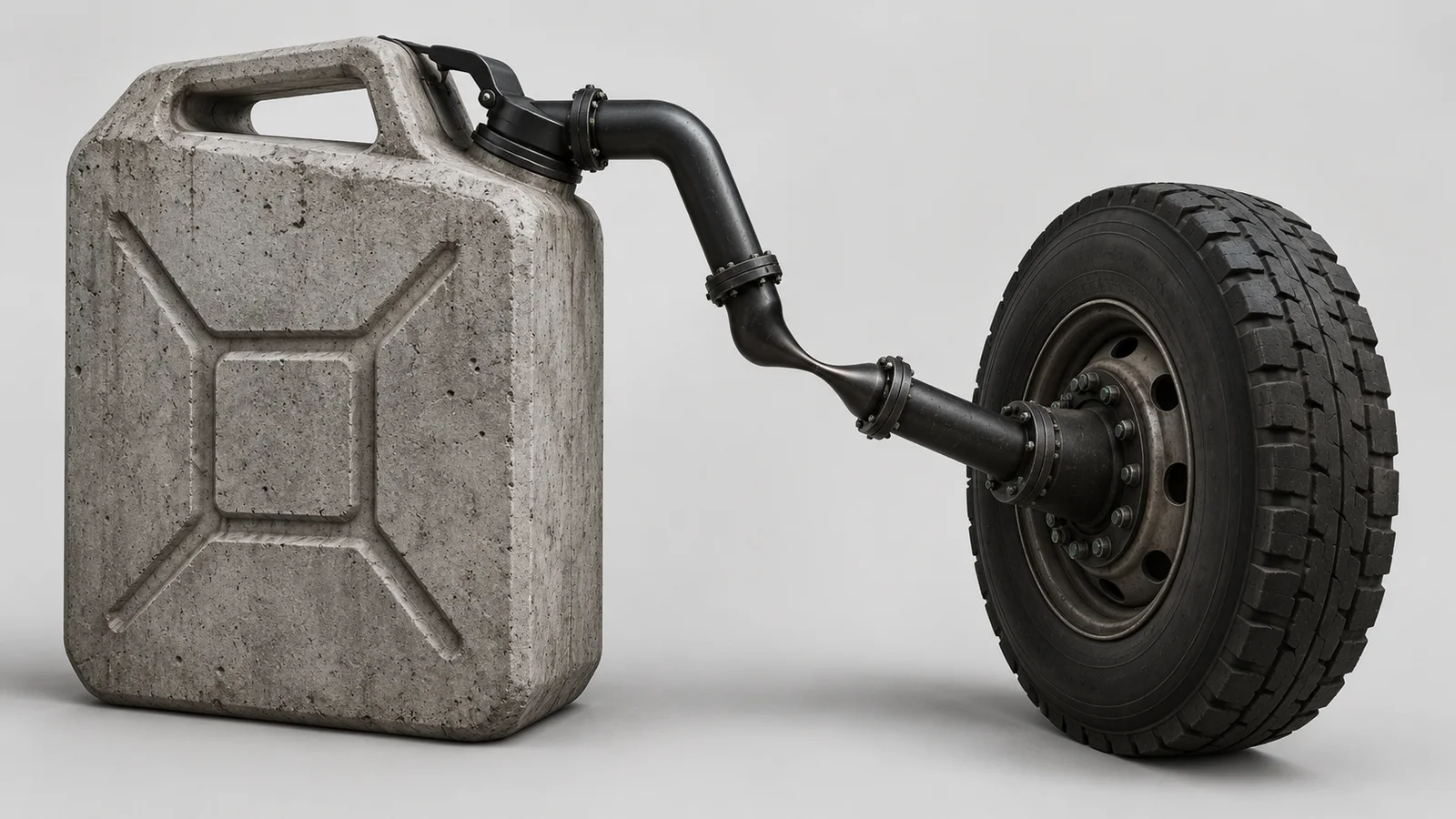
A barrel of crude oil cannot go straight into a delivery lorry. Before it becomes useful diesel, it must pass through refining, storage and transport. That simple distinction explains why an emergency oil announcement can sound more decisive than the relief a business actually experiences.
Germany plans to release up to 15 million barrels under the coordinated effort to ease the current squeeze, Reuters reported on 9 October. The plan concerns diesel, heating oil and crude. It is a commitment to make stocks available—not proof that the whole volume has already reached buyers. [1]
The wider international effort also needs to be read carefully. Reuters reported on 7 October that the IEA was seeking faster delivery of stocks remaining from earlier commitments. Accelerating a release is not the same as adding an entirely new volume to the total previously announced. [2]
The distinction is more than bookkeeping. It tells readers whether a policy changes the amount of supply, its timing, its location or some combination of the three. For a business needing usable fuel now, those differences are consequential.
The missing middle of the oil story
Crude benchmarks receive much of the attention because they offer a recognisable number. Diesel has its own chain of production and delivery. The EIA describes its retail price as reflecting crude costs, refinery processing, marketing, distribution, retail operations and taxes. Local conditions affect the result. [3]
An improvement at one point therefore need not solve a problem at another. Crude can be available while the capacity to turn it into the required product is constrained. A refined product can exist but be in the wrong place. A storage release can be authorised before the logistics needed to move it are complete.
This is why the type of stock matters. Releasing usable diesel can address a different problem from releasing crude that still needs refining. The commercial specification matters too: a fuel has to be suitable for its intended use. A headline total cannot tell the whole story of what becomes available to whom.
The IEA’s 2 October account of the energy-security discussions distinguished recovering crude flows from more persistent constraints in refined products, with particular concern about diesel. That is a description of a market bottleneck, not merely a higher version of the usual oil-price debate. [4]
Time is what a reserve buys
Emergency stocks are valuable because the alternative may be waiting for normal supply to adjust while disruption continues. Making them available can bridge part of that interval.
But the intervention needs a destination and a schedule. What can be delivered this week is different from what can be offered over a longer period. A reserve is also finite. Its release is most useful when it buys time for a credible adjustment rather than substitutes for explaining whether that adjustment is taking place.
None of this means stock releases are pointless. It means their effectiveness should be judged against the bottleneck they address. If the immediate issue is access to product in a particular region, getting the right product there matters more than announcing a larger total in the abstract.
There is also a reason not to promise a precise retail outcome. A stock release changes one element in a market with other moving parts. Demand, commercial inventories, transport constraints and expectations can move at the same time. A falling price after a release is not, by itself, a clean estimate of its effect; an unchanged price is not proof that it had no cushioning effect.
The bill travels through the economy
Diesel-dependent activity connects the fuel market with goods and services that do not carry a fuel label. The relevant question for a delivery business is its total cost of completing the route. For a customer, it is the price and reliability of the service.
A business facing a higher input cost has choices, but not unlimited ones. It may absorb part of the increase, alter operations, renegotiate a charge or pass a cost on. The ability to do each depends on contracts and circumstances. That is why a fuel shock should not be converted into a universal prediction about every product’s price.
An essential shipment and a discretionary journey may respond differently. A large operator and a small one may also have different room to manage timing or negotiate terms. These are pathways to investigate, not evidence that every business in a category has already behaved in the same way.
For consumers, the result can be indirect. A delivery charge or an item’s retail price may carry part of the pressure. Other costs may counteract or amplify it. It takes a specific chain and a consistent period to establish the effect rather than simply placing a diesel chart beside a food bill.
Relief is not resolution
The current policy discussion risks asking emergency measures to deliver more than they can. A reserve release can help with availability. It cannot, on its own, settle a conflict, rebuild damaged capacity or ensure that every supply route operates normally.
The useful public update is therefore a sequence rather than a single triumphant announcement: what was pledged, what was offered, what was moved, where it arrived and which constraint remained afterwards.
That sequence also allows a fairer judgment of the intervention. It can reveal useful progress without claiming that the market is fixed. It can expose an implementation problem without assuming that the original decision was unnecessary.
The pump price is where much of the anxiety becomes visible. The more important explanation often sits further back: in the type of fuel available, the facilities that make it and the route by which it reaches the engine. Until those links are understood, a large number of barrels can still leave the practical question unanswered.
Sources & notes
Explore the sources cited in this article.