
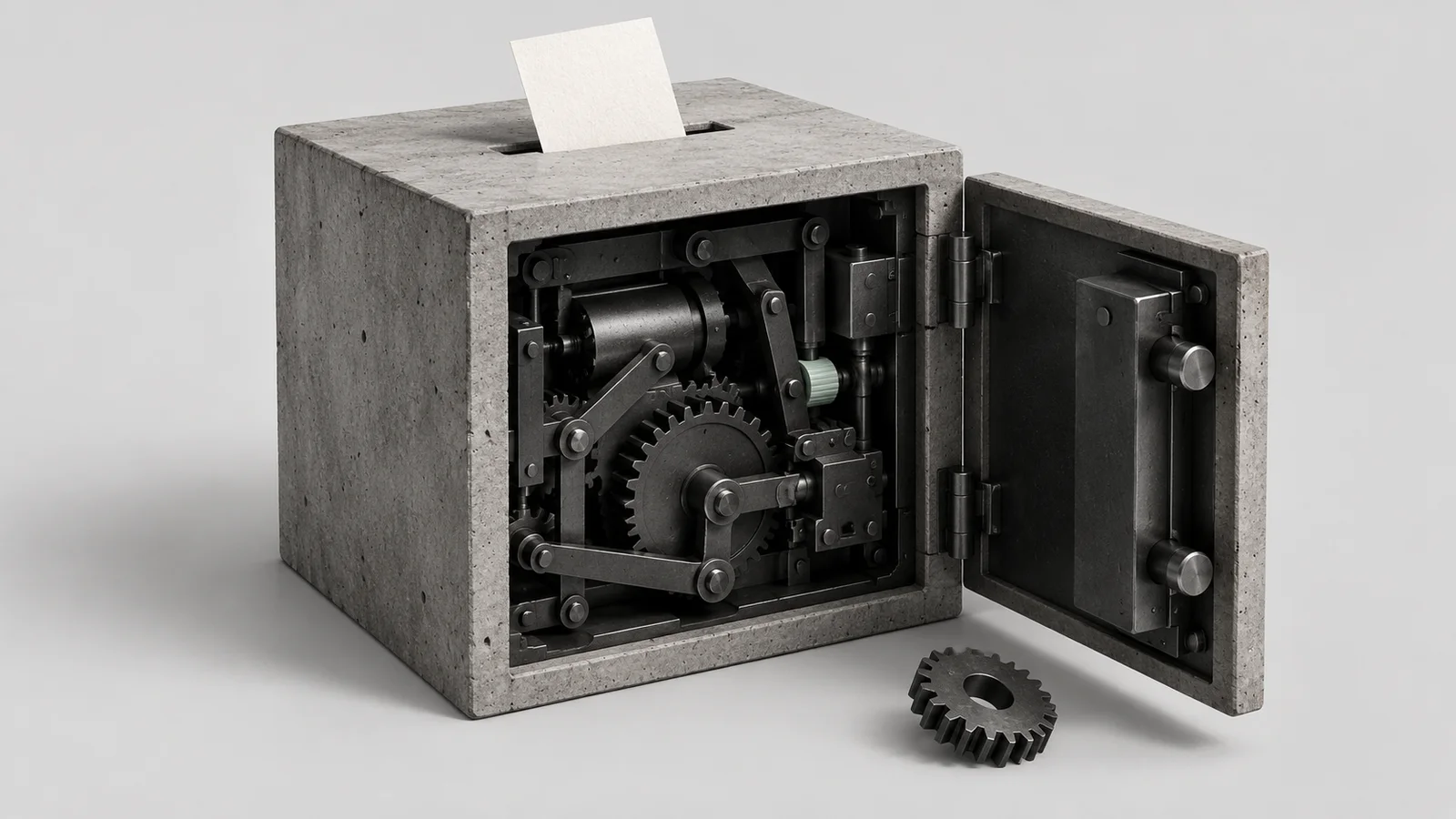
An election has a date, a count and a result. The restraints on a government are harder to photograph. They appear in whether a court can hear a challenge, whether a legislature can obtain an answer and whether a journalist can investigate an uncomfortable fact without losing the ability to work.
That quieter part of democratic life is at the centre of International IDEA’s latest assessment. Its September report draws attention to weakening rule-of-law protections. The useful question is not simply where a country sits in a table. It is which institution is changing, how that change affects the ability to question power, and what evidence supports the assessment. [1]
The ballot remains essential. But it is not a receipt showing that every part of democratic government will function until the next election. Winning authority and placing limits on its use are connected responsibilities, not alternatives.
Four questions, not one verdict
International IDEA’s framework separates representation, rights, rule of law and participation. It deliberately avoids collapsing the whole picture into one overall score. The underlying method brings together different indicators and sources, acknowledging that no single measure captures every feature of democratic life. [2]
That approach is useful for readers as well as researchers. A country can change differently across institutions. A single celebratory or catastrophic label may conceal the part of the system that is actually improving, or the one that is becoming vulnerable.
Consider the practical questions instead. Can opposition parties organise and compete? Can the people affected by a government decision seek a remedy? Can an oversight body obtain documents rather than merely request them? Can a public official explain an unfavourable decision through reasons that apply consistently?
These questions do not ask whether every person likes an outcome. A court can uphold a policy that is deeply unpopular with some citizens and still perform an independent function. An oversight committee can make an uncomfortable finding that deserves challenge on the evidence. The test is not agreement. It is whether the process remains capable of producing an answer that those exercising power did not control in advance.
The day after the vote
The winner of an election needs sufficient authority to govern. A system in which every ordinary decision can be indefinitely blocked can frustrate the very accountability elections are intended to provide. Voters should be able to connect a programme with its results rather than hear that no institution was ever responsible.
Yet an electoral mandate cannot answer every question about how that programme is carried out. A vote does not inspect a procurement contract, hear a particular rights complaint or test whether an administrative decision followed the law. Other institutions exist because those tasks require different kinds of scrutiny.
This is where arguments about “obstruction” become consequential. Sometimes delay reflects a badly designed process. Sometimes it reflects a safeguard doing precisely the work for which it was created. The description alone cannot settle the matter. A government seeking to remove a restraint should be able to explain the problem, the proposed replacement and the protections that would remain.
The same standard should apply to those defending the restraint. Independence is not a promise of perfection. Courts, public agencies and oversight bodies need transparent procedures and a way to correct mistakes. Shielding an institution from any criticism is not the same as protecting it from improper control.
Read the period behind the headline
The new IDEA report makes an important methodological point about comparisons over time. Its global analysis excludes improvements in one basic-welfare factor because recovery from pandemic conditions would otherwise disproportionately shape the picture. It also identifies the historical observation period behind its comparisons. A report published in 2026 is not a daily measurement of every event in 2026. [3]
That qualification is not an invitation to disregard the findings. It is a reminder to read what a statistic measures before asking it to explain a political development.
A decline in an indicator may identify a serious pattern. It does not, by itself, establish the motive of every official involved or demonstrate that one policy caused the change. For that, readers need the underlying legal, institutional and historical evidence. Equally, the absence of a dramatic movement in a national indicator cannot establish that a particular abuse did not occur.
The best use of a democracy assessment is therefore diagnostic. It can tell journalists and citizens where to look more closely. It should not replace examination of the actual decision, appointment, judgment or enforcement practice at issue.
A public habit of asking for reasons
The space between elections is also where participation becomes more than an occasional act. The people affected by a decision may hold information that a national debate overlooks: whether an appeal route is usable, whether an official notice can be understood, whether a consultation accepts evidence in practice rather than only in principle.
Their experience is valuable, but it still needs context. One account can reveal a problem worth investigating; it is not automatically a representative survey. A pattern needs documentation. A claim of institutional capture needs more than a disagreement with a particular result.
This is a demanding way to follow politics. It asks for attention after election-night drama has ended, and for distinctions that do not always reward instant certainty. It also keeps the conversation close to the practical meaning of democratic authority: the ability to make decisions, coupled with the obligation to answer for them.
The next time a government announces that it is strengthening, streamlining or reforming an institution, the useful question is not whether the language sounds democratic. It is who will be able to challenge a decision afterwards—and whether that challenge can still change anything.
Sources & notes
Explore the sources cited in this article.