
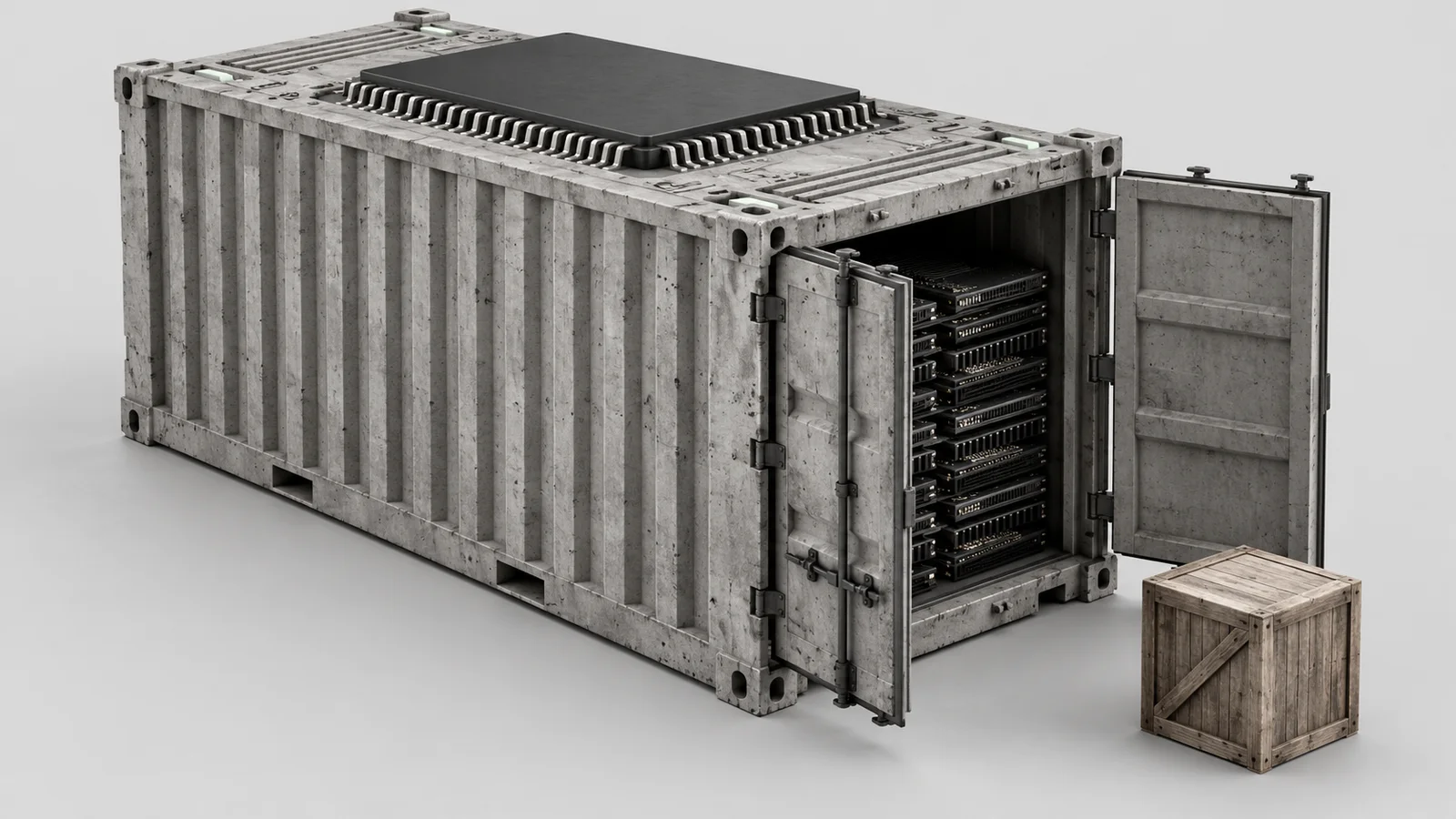
A server crossing a border is counted as trade. The benefit it might eventually bring to a shop, factory or worker is not contained in the same number. That gap is the most interesting part of this week’s stronger global trade outlook.
The World Trade Organization has raised its forecast for merchandise trade-volume growth in 2026 to 3.9%, from the 1.9% projected in March. Reporting on the 8 October update identifies investment in AI-enabling equipment as a major source of strength despite the disruption in the Middle East. [1]
It is an impressive correction to expectations. It is not evidence that every business is enjoying a boom, that the conflicts affecting trade have become harmless, or that the economic promise of artificial intelligence has already reached household incomes.
The immediate story is about equipment and the supply chains that produce it. The wider story is about who can turn that investment into something useful—and who may experience its costs before its benefits.
Follow the equipment before the promise
Semiconductors, servers and associated infrastructure are physical goods even when the services they support appear intangible. They have to be made, moved, installed and operated. Their movement gives an investment surge a visible footprint in merchandise statistics.
AP’s account of the WTO update reports that trade in AI-enabling goods rose sharply in the first half of the year. Reuters’ account distinguishes the stronger merchandise outlook from a weaker services forecast, affected by transport and aviation costs. Those are different parts of the world economy moving in different directions. [1][2]
This distinction is easy to lose in an optimistic headline. Strong demand for computing equipment can offset weakness elsewhere in an aggregate. It cannot compensate a particular firm automatically. A business dependent on an expensive shipping route does not receive a rebate because another sector’s exports are expanding.
The meaning of the measurement matters too. Trade value records the money associated with transactions; a volume measure tries to distinguish changes in the quantity of trade from price changes. A forecast is a projection for a period not yet complete. None of these is interchangeable with an estimate of wages or productivity.
The right response to the stronger outlook is therefore neither to dismiss it nor to turn it into a universal verdict. It is to examine the engines and the transmission.
There is more than one way to benefit
The most direct opportunity belongs to the businesses supplying the investment. An order for equipment can support demand for components, logistics, installation and associated services. But the domestic benefit depends on where those activities occur and how much of the value they create remains in the economy being discussed.
An export total is not the same thing as local value added. A product may cross a border after incorporating inputs from several places. Counting its sale does not tell the reader how the proceeds are distributed among suppliers, workers, lenders, owners and the public sector. That requires a different set of accounts.
The second possible benefit comes from using the equipment. A company outside the hardware supply chain might obtain a more capable service, reduce a task’s cost or improve an existing product. The path from infrastructure spending to that result has several steps: access, adoption, practical integration and a change that can be measured.
Then there is the distribution of the improvement. A firm might use a gain to lower a price, increase pay, invest further or retain a larger margin. More than one can happen. But none follows mechanically from the arrival of a server.
This is why the wider AI dividend cannot be read from a customs series alone. Hardware demand establishes that investment is taking place. It does not establish that every application works, that its return exceeds its costs or that a worker shares in the value it creates.
A concentrated engine can pull hard
UN Trade and Development’s new outlook describes a global economy in which stronger activity and opportunity are unevenly distributed. Its broader warning is relevant here: growth in an important part of the system can coexist with countries and groups that have much less room to benefit. [3]
There is no contradiction in a powerful investment engine and a narrow initial distribution of gains. The question is whether the circle expands.
For a smaller firm, the decisive issue may not be whether computing hardware is being traded somewhere. It may be whether a useful service is available on terms it can afford, whether its own processes can use it and whether staff have the time and skills to make the change worthwhile. These are practical barriers, not a reason to assume the technology has no value.
For a country outside the main equipment supply chain, the opportunity might lie in services, applications or complementary infrastructure rather than manufacturing the most advanced components. But that possibility should be presented as a route to investigate, not a guarantee that every economy can reproduce the same development strategy.
The strongest version of the optimistic case is not that concentration does not matter. It is that an initially concentrated build-out can make capabilities more widely available. That claim deserves to be tested through actual adoption, competition and outcomes rather than treated as either inevitable or impossible.
Resilience is not immunity
The WTO revision also demonstrates why a shock does not always produce the global outcome initially feared. Supply can adjust, purchasers can change sources and a different area of demand can provide support. The organisation’s update, as reported by AP, points to alternative supplies helping cushion disrupted energy flows. [1]
But a system that adapts still pays for adaptation. A route that keeps goods moving may be longer or more expensive. A substitute supplier may be available without being equivalent on every commercial term. Resilience means that something continues to work; it does not mean that the original shock had no cost.
This is important for the months ahead. The forecast depends on assumptions about demand, supply and disruption. If the pace of AI investment changes, an engine that surprised forecasters on the upside could also become a source of uncertainty. That is a conditional risk, not a prediction of a collapse.
The sensible test is to watch the breadth of the expansion. Are more sectors contributing? Are services recovering alongside goods? Are firms outside the initial supply chain recording useful productivity improvements? Are those improvements showing up in prices, wages or better products?
The next story is about the carriages
A stronger trade forecast creates an opening. It can support investment decisions, provide a more resilient base for economic activity and challenge assumptions that disruption must overwhelm every source of demand.
What it cannot do is finish the distributional argument. The journey from an equipment order to a better household budget remains a series of decisions and measurable results, not a line already completed on a chart.
The AI engine is pulling hard. The next question is not whether the headline is large enough. It is which carriages are attached, which are merely travelling nearby, and whether the people waiting further down the line can actually get aboard.
Sources & notes
Explore the sources cited in this article.