Dubai has spent two decades making property easy to buy.
The question is no longer who can afford a property in Dubai. It is how small a share of one the market is willing to sell.
It has spent rather less time making property easy to own.
The distinction matters. A market can be liquid, well regulated and open to foreign capital, and still ask a first-time buyer for a deposit that takes a decade to assemble. For most people in the city, the barrier has never been appetite. It has been the size of the smallest available ticket.
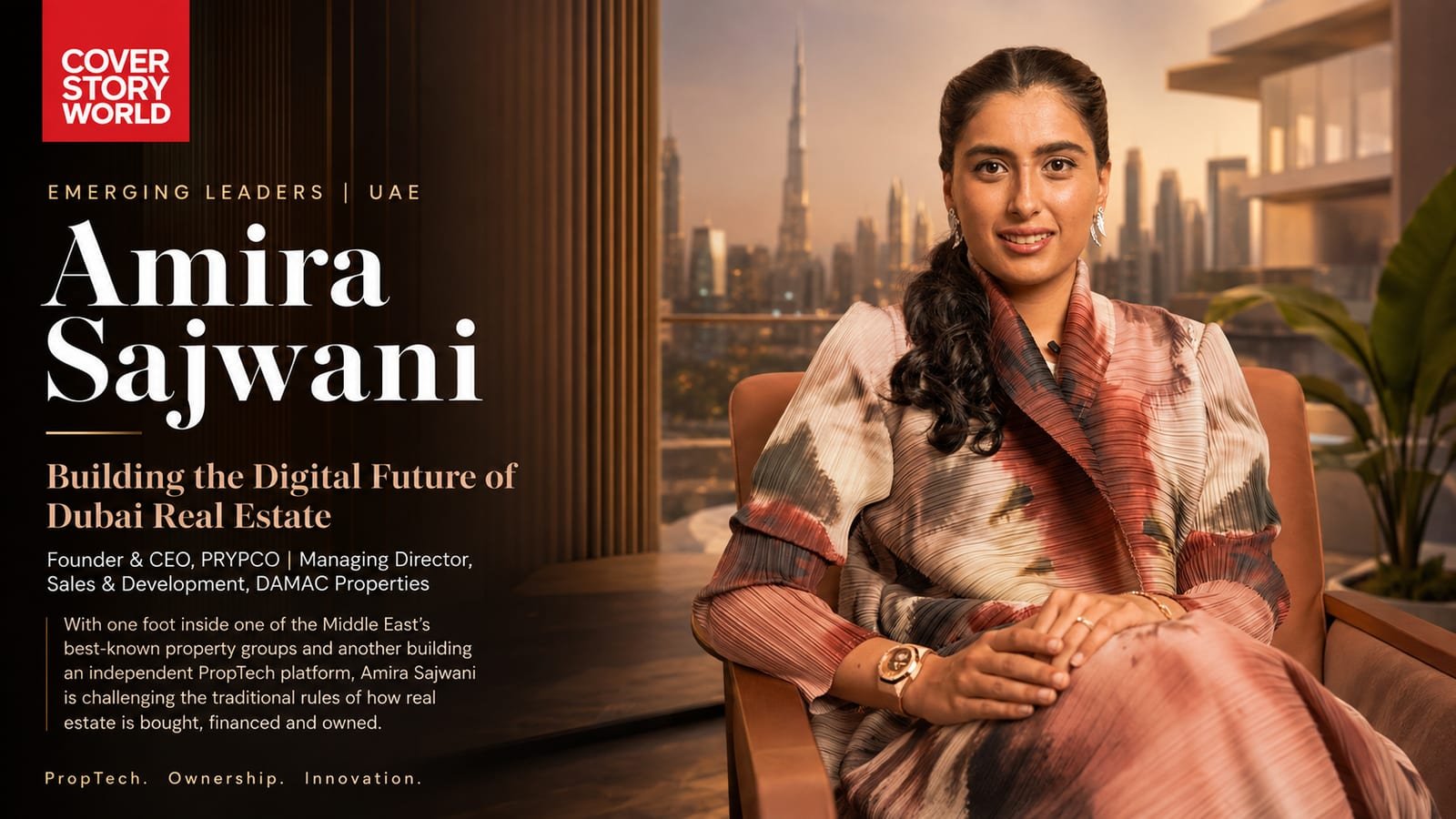
Amira Sajwani has built her career on both sides of that problem.
As Managing Director of Sales and Development at DAMAC Properties, she works inside one of the region’s best-known developers — a business founded by her father, Hussain Sajwani, and one of the companies that shaped how Dubai sells property. As Founder and CEO of PRYPCO, she is building an independent technology platform aimed squarely at the part of the market that traditional development does not reach.
Those two roles are not a contradiction. They are the argument.
Two Roles, One Thesis
Next-generation leadership inside a large family enterprise usually takes one of two forms. The successor either consolidates what exists, or builds something adjacent to it.
Sajwani has done both at once, and that is the more interesting choice.
The DAMAC role puts her inside the machinery of large-scale development: land, launches, sales, delivery. It is a vantage point on how the industry actually operates, including where it is slow, where it is opaque, and where it excludes people.
PRYPCO is the response. Rather than another developer, it is a platform layer — bringing together property services that the traditional market keeps separate, and aiming them at buyers the traditional market treats as too small to serve.
The opportunity may be inherited. The second business is not.
Lowering the Barrier to Ownership
PRYPCO’s central idea is fractional ownership: instead of buying a property, an investor buys a share of one, alongside others, with the asset held and administered on their behalf.
The mechanism is not new in global finance. What is new is applying it to Dubai residential property at a ticket size an ordinary salaried buyer can meet, and doing so inside a regulatory perimeter rather than around it.
The platform has extended into the services that sit around a purchase — mortgages, and the residency pathways that draw a large share of international buyers to the emirate in the first place. The logic is consistent: the friction in property is rarely the building. It is everything attached to it.
The question is no longer who can afford a property in Dubai. It is how small a share of one the market is willing to sell.
Tokenisation, With a Regulator in the Room
The more consequential move is PRYPCO Mint, which brings title-deed-backed property onto a tokenised platform — developed with the Dubai Land Department rather than in spite of it.
That last detail is the one worth holding onto.
Tokenised real estate has been attempted in many markets and has mostly failed the same way: the technology worked, and the legal ownership underneath it did not. A token that does not correspond to an enforceable title is a claim on nothing.
Building the register and the regulator into the design from the start is a slower route. It is also the only one that produces an asset a buyer can actually defend.
For Dubai, the initiative fits a broader ambition to be the place where the rules for digital asset ownership get written first. For Sajwani, it positions PRYPCO at the point where that ambition meets an actual transaction.
The Test of Next-Generation Leadership
The scale of DAMAC gives Sajwani a platform. It also sets the standard she will be measured against, and inherited standing is the least durable asset in business.
The harder test is whether PRYPCO becomes infrastructure or stays a product.
A platform that lets a few thousand people buy fractions of apartments is a good business. A platform that changes the minimum viable unit of property ownership in a major market is something else — and it would take years, several market cycles and a downturn to prove.
Fractional ownership is easy to admire in a rising market. Its real examination comes when prices fall and small investors discover exactly how liquid their shares are.
The Cover Story View
Amira Sajwani is attempting something more difficult than succession.
She is working inside an established developer while building a business whose premise is that the established model leaves most people out. Those two positions can be held together only if the second one is genuinely independent — in its technology, its economics and its willingness to compete with the way the industry has always sold property.
The direction is clear enough. Dubai real estate is moving from a market of whole assets and large cheques toward one of divisible, digitally held, regulator-backed shares.
Whether that shift makes ownership meaningfully broader, or simply creates a new instrument for the same investors, is not yet settled.
It is the right question to be building against.
Know a brand or leader like this? Nominate them for Asian Premier Brands and Leaders 2026. Entries close 16 October 2026.
Nominate


 Hazza Zaal · Al Barari Real Estate Group